

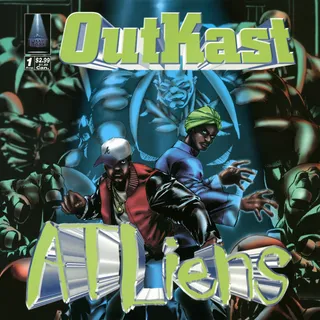
OutKast was always an exercise in friction. Long before the barely disguised breakup album that became their biggest commercial success, Dre and Big Boi chafed at one another, at different versions of themselves, at the past, the present, their genre, their neighbors. Their debut album, 1994’s remarkably accomplished Southernplayalisticadillacmuzik, was buoyed by a pair of hits so thematically discordant that they could only be held together by an impenetrable alloy of charisma and technique.
Two years later, when the Atlantans were just 21 years old, they returned with ATLiens, an album that finds a new vantage point on the outside world to burrow deeper into its authors’ own paranoias and insecurities. Suffused with dread and bathed in reverb, the record captures two virtuosos at their most vulnerable. Even when the revelations seem to be inadvertent, they add depth and dimension to the high school rivals-turned-partners who
Southernplayalistic allowed Dre and Big Boi to tour across the continent and in Europe. In interviews around the time of ATLiens’ release, both MCs, but especially Big Boi, cite this as a broadening experience for two teenagers whose lives had mostly been confined to the American South. But tour is also exhausting, and isolating; it’s a lot of airport terminals and interchangeable hotels and greenrooms that blur into a sort of purgatory with fresh towels and stale deli trays. For a nominally social endeavor, it leaves you alone with yourself an awful lot.
When Big Boi and Dre started working with Organized Noize—the production trio Sleepy Brown, Ray Murray, and Rico Wade, who had nurtured them as part of the Dungeon Family collective and produced Southerplayalistic—the accommodations were no itineraries, no concierges. “The basement wasn’t finished,” Big Boi said to Rolling Stone in 2004, recalling the place from which the Dungeon took its name. “We have red clay in Georgia, so the beat machines had dust on ’em. There were old broke-up patio chairs. You had seven people sitting on steps with their notebooks out. Guys sleeping upstairs on a hardwood floor. It was some gritty shit. We’d walk up to this deli inside a gas station and order the spaghetti special, because it came with five meatballs, so we could split it.” That was then. Now there was money; now there were deadlines. While OutKast toured, Organized Noize rented out the top floor of the Biltmore Hotel and started working on beats for the second album.
Meanwhile, the rappers had invested some of the money from their publishing deal in production equipment and begun tinkering with beats themselves. They worked diligently and smoked copious amounts of weed. Their emerging codependence refracted through both things: Any beat made by either one was credited, simply, to OutKast; because Big Boi didn’t yet know how to roll blunts for himself, Dre would prepare as many as 30 for him to go through during a single day.
But during this period, three crucial things happened which clarified (if not calcified) a difference in artistic approach between the two men. André, along with several other Dungeon Family members, took an extended trip to Jamaica. It was apparently transformative: Dre came back clean, sober, and celibate, a pivot that would be reflected in his suddenly more eclectic wardrobe. Big Boi couldn’t make the trip because of his aunt Renee’s passing. And in March 1995, he became a father. (Several years ago, during an interview for a magazine profile, Big Boi told me that it was the birth of his daughter that shaped a newly disciplined writing practice he continues to this day: jotting rhymes on a yellow legal pad with start and stop times noted in the margins, clocking in and out as if at a factory.) One half of the duo was more tethered than ever to the practical realities of adulthood; the other was free to imagine moving beyond them.
The opening five-song movement of ATLiens is not so much otherworldly as it is vaguely apocalyptic. “Two Dope Boys (In a Cadillac),” the title track, and “Wheelz of Steel”—the latter two produced by OutKast, the first by Organized Noize—are uniformly metallic and slightly distorted, a marked departure from the debut that was on the whole lusher and funkier. Yet that consonance of sound is complicated by the writing. No one who has ever heard “Elevators (Me & You)” has forgotten its languid hook. But the slick, slow boasts about slamming Cadillac doors don’t quite square with the disdain Dre expresses for the old classmate he runs into, who wants to know what kind of car he drives. Similarly, at the end of his first verse on “ATLiens,” Big Boi invokes his incarcerated uncle; this gives way immediately to the chorus that instructs you, “Now throw your hands in the air/And wave ’em like you just don’t care.” That line traces back to rap’s beginnings, a reliable party-starting instruction. Here, the men saying it sound more than a little defeated.
The same virtuosity that helped explain “Player’s Ball” and “Git Up, Git Out” as two sides of the same slick-but-industrious ethic is at play here. Actually, both rappers are notably sharper than they’d been before, rattling through intricate patterns that would seem like athletic feats for most other MCs. The pair is also so confident that they have no problem throttling down when it serves the song. On “Two Dope Boyz,” Dre describes a rapper challenging him to a battle—then simply steps out of the rhythm of the verse. “Look, boy,” he deadpans, “I ain’t for that fuck shit.” At times, Dre and Big Boi pack a half-dozen different flows into their verses on a single song. “Elevators” alone sees Big Boi’s stop-start “Back in the day when I was younger/HUNGER/Looking to fill me belly with that Rally’s/BULLSHIT” and Dre’s now-legendary lapse into double time:
